



BILLINGS — The first interview I conducted right after Jeff Choate was named Montana State head football coach in early December 2015 was with Mick Delaney.
Delaney — a venerable coach who brought Choate aboard his staff at UM Western in the early 1990s after his playing career with the Bulldogs ended — spelled out in no uncertain terms the type of competitor the Bobcats were getting, referring to the then-45-year-old Choate as enthusiastic, a disciplinarian and "a battler."
All of those things proved true. A tremendous energy source, Choate pulled MSU, which had slipped from the national prominence it tasted earlier in the Rob Ash years, back to relevance while establishing a new and obsessive psychology in the rivalry with Montana.
And the era of the "Griz Slayer" still echoes through the program.
Saturday's matchup between Montana State and Nevada is a high-profile reunion between the Bobcats and the man who rewired the DNA of the program. As the top-ranked team in the FCS, the Bobcats travel to Reno to face Choate's FBS Wolf Pack, a matchup that provides the perfect backdrop to recount the gradual build he orchestrated in Bozeman between 2016 and 2019.
Choate established toughness at MSU at a time when it was badly needed. His first two seasons delivered some obvious growing pains, but by the end of Year 3 and certainly in Year 4 the Cats were recast as an FCS power.
Oh yeah. He also never lost to Montana in his four seasons, doing it with physicality in the trenches and a swagger that shattered years of lingering inferiority complexes in Bozeman.
Then a reporter at The Billings Gazette and 406 MT Sports, my boss, Jeff Welsch, championed the idea of entrenching me in Bozeman to cover Montana State athletics full time, and in early August of 2015 we got the green light.
That ended up being the final season at MSU for both Ash and star quarterback Dakota Prukop. Two days after the Cats were unceremoniously beaten 54-35 by Bob Stitt's Grizzlies on Nov. 21, I managed to stumble onto the scoop that MSU was parting ways with Ash — one of my better professional moments (with insincere regrets to my friends and cohorts in the business).
Choate was subsequently named coach on Dec. 4, and my first call was to Delaney, who the season prior had finished a three-year run as head coach over the hill at Montana but had also spent a four-year stint at Montana State under his longtime coaching collaborator, Sonny Lubick, in the late 1970s and early 1980s. His connection to Choate at UM Western (then Western Montana College) was foundational.
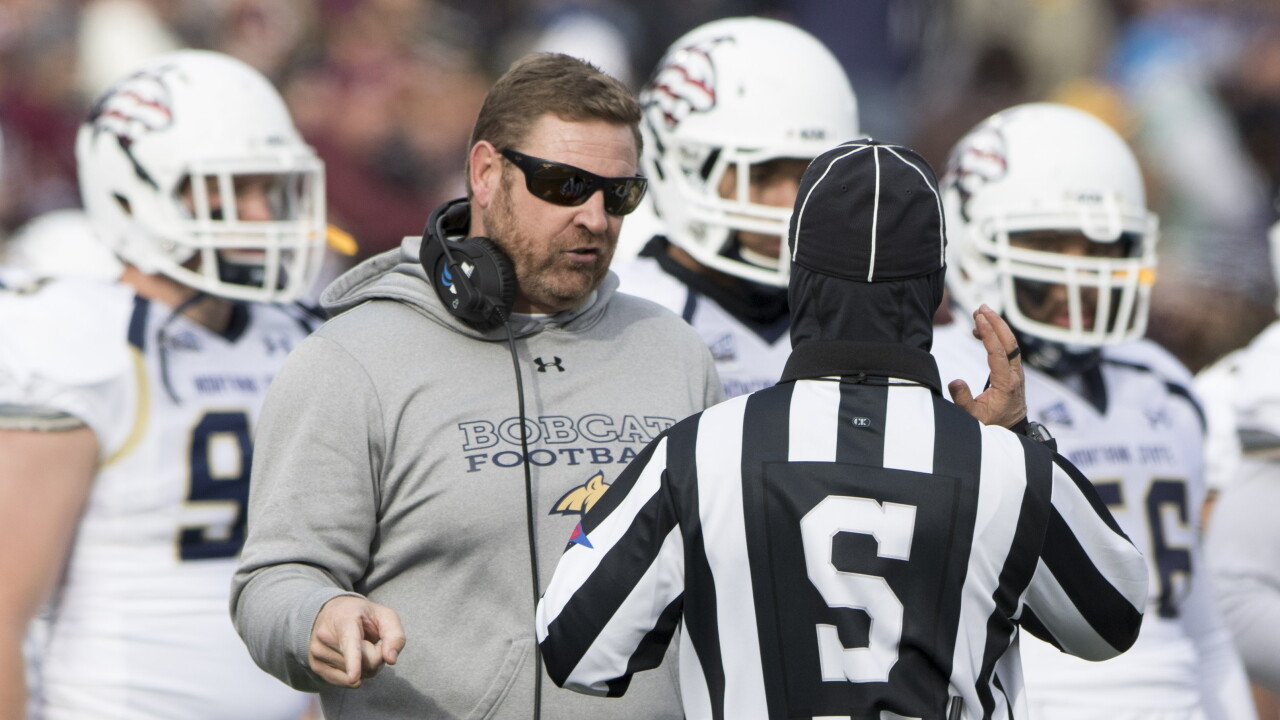
Delaney's description of Choate's passion held my attention. But it was something that had to be seen to truly be understood. I'd had a good rapport with Ash, a calm and even-tempered man whose demeanor was the opposite. If you grew up in this state in the '80s and '90s, it was amazing to see MSU rise to the nation's No. 1 ranking on Ash's watch. But he wasn't necessarily prone to wearing his heart on his sleeve. Choate certainly was, as I quickly found out.
A new brand of accountability
First, some personal reflections. And I apologize in advance for the length of this stream of consciousness.
Choate, rightfully so, got after me on more than one occasion.
Once, during a press conference after a 17-15 home loss to North Dakota on Sept. 24, 2016 — in one of those two blockhouses behind the north end zone that have since been replaced by the Bobcat Athletic Complex — I asked what I'll admit was a bit of a lazy question that Choate obviously did not appreciate, something about his level of concern over an offense that was spinning its wheels early in the season.
Another time, earlier during that fall camp, I attended a practice at the stadium and later reported on an injury sustained by an MSU player. Choate was not pleased, and he let me hear about it the next day. Under Ash, injury reportage wasn't subject to very strict containment, but my assumption that things would be the same under Choate was a bad call.
Now, I had made my bones covering Bobcat games in the Ash and, before that, the "Big Human" Mike Kramer eras, so all of this was new. I've never been the greatest question-asker anyway, and making assumptions is a no-no in this business. And Choate, the head of a new regime at MSU, clearly had no tolerance for either.
But it swung both ways.
On one occasion, Choate called my cellphone to compliment me on a story I'd written that evolved from a one-on-one sit-down we'd done in July of 2016. The article was about the nationwide epidemic of campus sexual assault, Choate's concern about it and the steps he'd taken institutionally to educate his players.
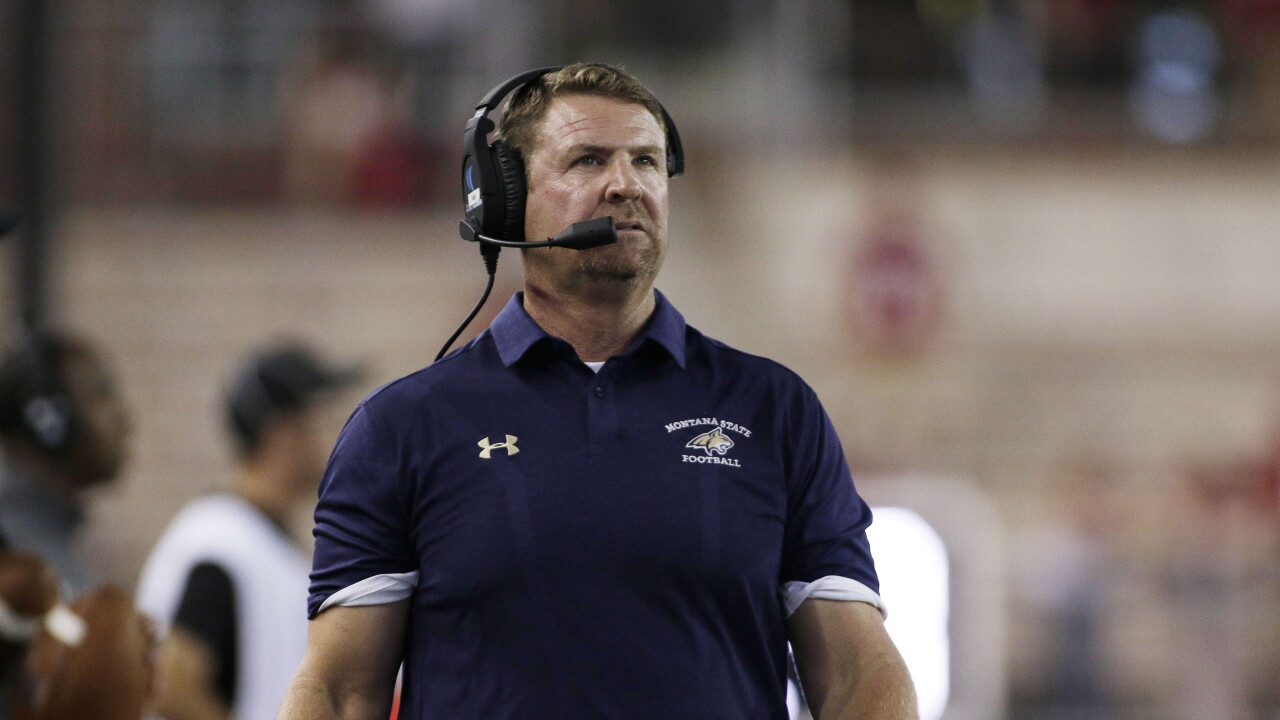
Another time, at a press conference two days after his perfectly executed timeout with mere seconds left in the 2018 Cat-Griz game led to a shocking fumble and a stunning 29-25 come-from-behind MSU victory, I was still baffled by how that entire sequence played out.
If you remember, Choate seemed to wait an excruciatingly long time to take the timeout — the Griz had snapped the ball just milliseconds, it felt like, after he'd made the call and apparently scored what would have been the game-winning touchdown. Frankly I was surprised the line judge granted it. But as Choate explained, he wanted to get a good look at Montana's offensive formation, so the timing was everything.
After the timeout, the Griz, surprisingly, ran the exact same play. Only this time Tucker Yates and Grant Collins forced a fumble on the goal line that Derek Marks recovered.
I was astonished by it. Never has a timeout in football been more effective. Especially considering what had happened in the aftermath. I asked two questions about it near the end of that particular press conference back in Bozeman. Choate seemed perplexed by my amazement. What's so complicated about a timeout?
At the end of the media session, as I walked toward the table to retrieve my recorder, I said something out loud like, "By the way, that was a heckuva timeout." It drew a hearty laugh from the coach. Maybe you had to be there.
I suppose the point of all this is that Choate demanded excellence and held people accountable — not only from his players and assistant coaches but also from the people reporting on his team. You either came prepared or it would become obvious to everyone in the room that you weren't.
I can honestly say that Choate helped me become better at my job, which I guess is as fine a compliment a reporter can give any coach. For that, but not only that, I respect the guy.
'Beat the Sky, own the state'
Choate's four years at Montana State were an exercise of heavy lifting and a study in culture change. With appreciation for a storied football history at MSU, he essentially tore things down to build it back up again.
He inherited a squad that in recent years prior had featured some of the best individual playmakers in its history — certainly at the quarterback position — and an unrelenting offense. But it also seemed to lack the consistent armor in the trenches to survive late in the playoffs during an incredibly competitive era of FCS football.
Thus, in came an unyielding investment in fortifying things up front, particularly on defense, and a bruising yet explosive running game that could take opponents' souls. Choate's mandate? That any player wearing an MSU uniform would outwork and outhit the man across from him.
Choate, instinctively I think, understood the power of social media at a time when not many FCS teams were utilizing it to their advantage. He also grasped the value of establishing a narrative and getting a message across through the media. I have no doubt it all helped in recruiting, especially within the state.
And then there were the on-field results against Montana. For years in Bozeman, more so than in Missoula, coaches were ultimately judged on whether or not they beat the Grizzlies — fair or not.
In the 30 years between 1986 and 2012, the Bobcats toppled Montana just five times. Since Choate's arrival and continuing into the Brent Vigen tenure, the Cats have now won eight of the past 10. Things are clearly different now.
Choate, of course, went 4-0 versus the Griz as the Bobcats proved to be the tougher team up front each time. The hope of beating Montana suddenly became an expectation.
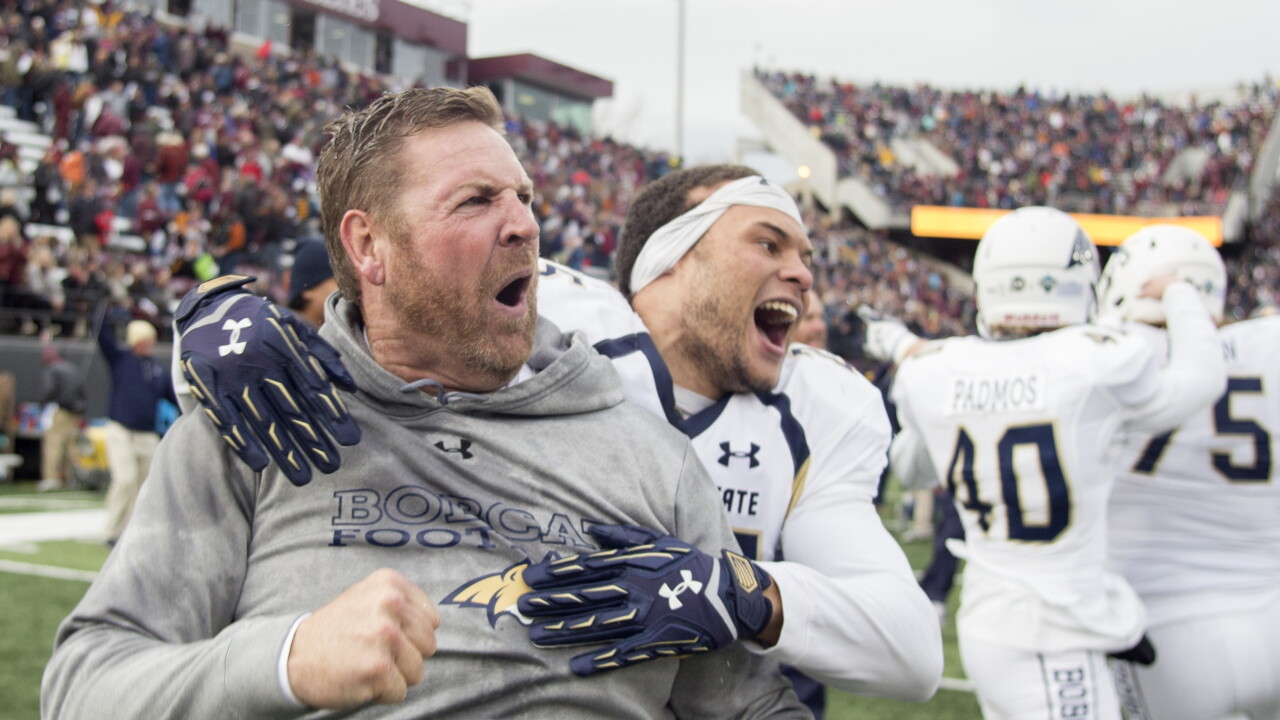
In 2016, the Cats completed just two passes but rushed for 368 yards, including 142 and two touchdowns by QB Chris Murray in a 24-17 win in Missoula. The following year it was more or less the same thing, with MSU rushing for 322 yards in a 31-23 victory.
In 2018 they made a dramatic comeback, punctuated by the aforementioned goal-line takeaway. But sophomore Troy Andersen became a Bobcat legend that day, accounting for three touchdowns at quarterback as MSU erased a 22-0 first-half deficit.
And then in 2019 it was no contest: Montana State rolled to a 48-14 victory on the strength of 382 rushing yards. The Bobcats ran the ball 62 times while throwing it only 14. Isaiah Ifanse and Logan Jones combined for 292 ground yards and four TDs.
In four wins over the Griz, Choate's Bobcats averaged 325.3 rushing yards. Quarterback was a constant revolving door, but the ground game was a clear impact of MSU's new DNA. And it's only continued under Vigen, with the Bobcats remaining among the top rushing teams in the FCS in the past five seasons — with a QB position that has been totally solidified.
Passing the torch
By 2019 the Bobcats were back on the national map. The Choate Doctrine had come to life. They just couldn't get past North Dakota State in the playoffs. Who could? MSU's season ended at the Fargodome in back-to-back years, including in the semifinals in '19.
The 2020 Big Sky Conference season, of course, was wiped out by the SARS-CoV-2 pandemic, and in January of 2021 Choate was on his way to Texas to coach linebackers and co-coordinate the Longhorns' defense under Steve Sarkisian.
Vigen was a candidate to replace Choate from a pool of names that included (among others) Ken Wilson, who was then the linebackers coach at Oregon, and Matt Lubick, who was the offensive coordinator at Nebraska.
(Choate, as it happens, later replaced Wilson as the head coach at Nevada.)
In the end MSU came away with Vigen, who stepped into an ideal situation with a built-to-win program and has only made it stronger. He coached the Bobcats to national title-game appearances in 2021 and 2024 — both losses to NDSU — before beating Illinois State to bring home MSU's first championship in 41 years last season. While Choate established supremacy over the Griz, Vigen did so too against the likes of Eastern Washington and Weber State, teams Choate failed to beat.
Now in his sixth year in Bozeman, Vigen is 63-12 overall, 38-3 in Big Sky Conference games and is 41-2 in games at Bobcat Stadium. Ridiculous numbers. I often wonder what the program would have done had Choate stayed, and I am not sure it would look a whole lot different right now. But that's only speculation.
Vigen again has MSU ranked No. 1 in the FCS heading into Saturday's matchup with Choate and FBS Nevada.
When Choate left for Texas, I thought that was a good time for me to step away from the day-to-day beat. And by the following summer I had left the newspaper after two decades to join the digital sports staff with the Montana Television Network. But I still find myself at various games and Big Sky Conference events. And I am still able to write from the interviews I do and the observations I have.
Needless to say, this week's game will be very closely watched. It's a hugely important contest for Choate and his staff at Nevada — which also includes Bobcat connections in defensive coordinator Kane Ioane, secondary coach Joey Thomas and assistant special teams coordinator B.J. Robertson. Now in his third season in Reno, the Wolf Pack are 7-19 under Choate. A loss to the FCS Bobcats, who as of midday Wednesday were 4.5-point road favorites, would do Nevada no favors.
But for all the storylines surrounding the stakes and an anticipated reunion of the past and present, the Montana State program still bears Choate's fingerprints. Choate may have departed before he could finish the job in Bozeman, at least in the championship sense. Vigen ultimately did that. But the foundation that made it possible was built during those four intense years when the standard inside the program shifted.
A decade after he arrived at MSU, Choate — the consummate battler — will now find himself on the opposite sideline staring back at a machine he helped build. And no matter what happens on Saturday, Choate's impact on the Bobcats can't be separated from what they have become.
Game on.
