

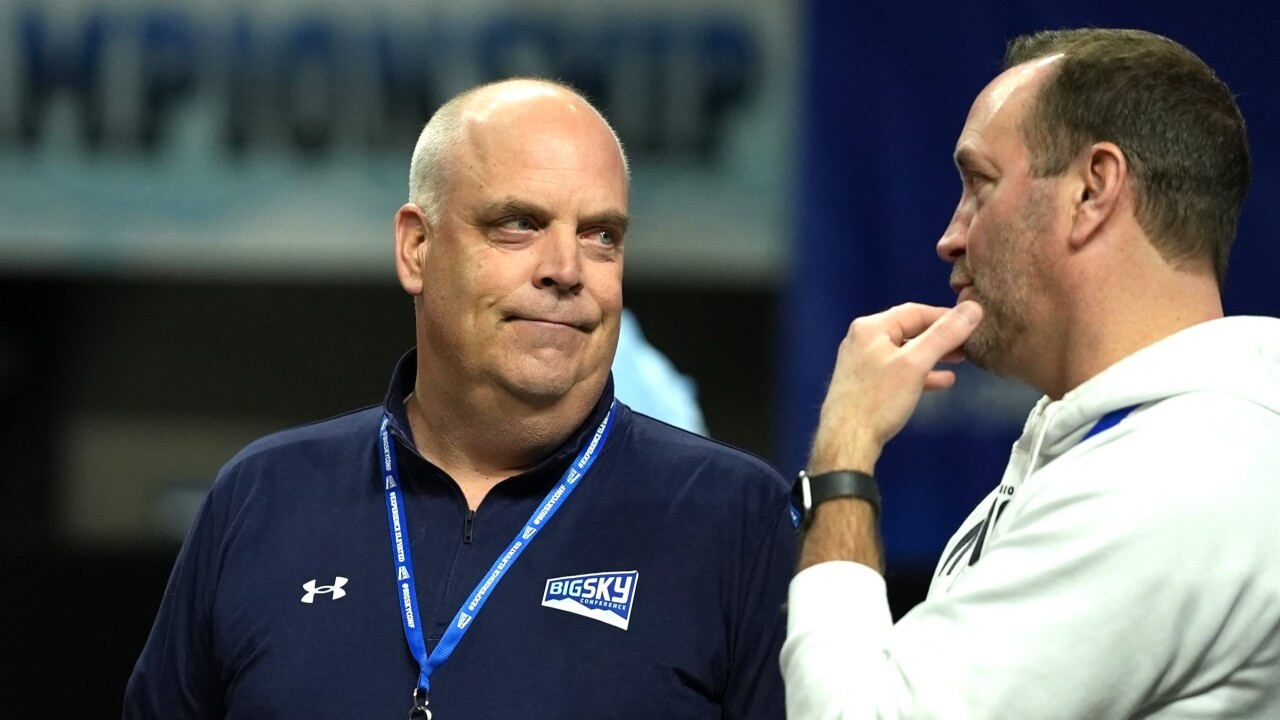


Editor's note: This is the first story in a three-part series from of a wide-ranging interview between MTN Sports' Greg Rachac and Big Sky Conference commissioner Tom Wistrcill that took place March 9 at the league's postseason basketball tournament in Boise, Idaho.
BILLINGS — Idaho, you're up.
No pressure, of course. As a No. 15 seed, you've got a heck of a challenge against Houston in the first round of the NCAA men's basketball tournament.
Not that the Vandals are the Big Sky's latest sacrificial lamb in its pursuit to break a two-decades-long spell of March Madness futility, but they opened as 23½-point underdogs for their first-round matchup against the second-seeded Cougars on Thursday in Oklahoma City.
It's an uphill battle.
Still, Idaho is one of the darlings of March as it makes its first trip to the NCAA tourney since 1990 — since before Orlando Lightfoot set a heavy foot on campus and became one of the greatest players in Big Sky history. It's been long overdue.
But know this: A Big Sky victory on this sport's biggest stage, last achieved when Montana beat Nevada in the first round of the 2006 tournament, is also a long time coming. And that delinquency is not something that's lost on the conference. At all.
"We're anxious. Anxious is actually a great word," Big Sky commissioner Tom Wistrcill told MTN Sports during a sit-down interview in his suite overlooking the league-tournament action last week at Idaho Central Arena in Boise — not apropos of Idaho or any specific team.
"We need to find a way to win a game. It's gotten more difficult in the transfer-portal era for us to hold on to our best players. But we have really good teams. We can compete against those teams in the NCAA tournament."
The Big Sky's last best chance to win — and its last best opportunity to tap into a long-unrealized revenue reservoir — was in 2024 when Montana State unexpectedly captured the Big Sky tourney and, after winning just 14 regular-season games, was sent to Dayton, Ohio, for a 16-vs.-16 matchup in the First Four against Grambling State.
The Bobcats led by as many as 13 points early in the second half but were eventually felled in overtime, 88-81. The loss was tough for MSU to swallow. For the conference and its institutions, an extra $2 million of shareable earnings — known as a "unit" — slipped out of reach.
The Big Sky has only won three times in the NCAA tournament since the bracket expanded to 64 (and now 68) teams in 1985:
- 1995: No. 14 Weber State 79, No. 3 Michigan State 72
- 1999: No. 14 Weber State 76, No. 3 North Carolina 74
- 2006: No. 12 Montana 87, No. 5 Nevada 79
Weber State dang near made the Sweet 16 in both 1995 and '99. The Wildcats lost on a last-second tip-in in their second-round game to Allen Iverson and Georgetown in '95 and in '99 pushed Florida to overtime. Meanwhile, Montana's 2006 win was the perfect matchup against a "like" first-round opponent that was once a member of the Big Sky Conference.
That turned out to be the perfect formula. The Grizzlies got a higher seed at No. 12 that year — which always comes with upset potential — partly by virtue of a top-60 RPI ranking.
Now the NCAA selection committee uses an NET index (NCAA Evaluation Tool) to build the bracket. It measures, among other things, strength of schedule and success against teams from "quadrants" (with the highest-quality wins raking as Quadrant 1). Idaho's NET ranking entering this year's tourney is 145.
"I think we need to get an upset in a Q1 game," Wistrcill said. "We need to win a few Q2 games, and then we'd need somebody to — not that they have to be Miami (Ohio) and be 30-0 — but we probably need to have a team with two, three losses total, which means maybe you're going 1-1 in Q1 and maybe you're 2-0 in Q2. And then when you play in the conference schedule you get, like, one loss, and then you win here in Boise. That's how we get a 12 seed. But that's really hard. Really hard."
But with each passing year the drought becomes more dusty and arid.
In this extended quote, Wistrcill indicated his interest in seeing the NCAA expand the tournament further to help give the Big Sky and leagues of its ilk a better chance:
"There were two things that have driven me nuts in my eight years here," he said. "One was winning a national football championship, and No. 2 is winning a game in the men's and women's basketball tournament, because there's revenue attached to both. As you know, we were able to accomplish the first one when Montana State won the title. So that's great.
"It is about matchups and all that, but I think we've got the type of players. And I think from a coaching standpoint we have a really good set of coaches in order to win a game, one 40-minute game against a Wisconsin on a neutral court for example. We're going to have to play our best game. We also have to get a little lucky there.
"I've also become increasingly interested in expanding the tournaments. In the studies that I've seen, in eight out of 10 years, our men's champion would get a chance to play a like opponent in the opening round. So now that gives us a 50/50 chance to get a unit. I'll take those odds.
"Right now, the way it works is you have to win with us being in the 14-15 (seed) range beating a 2 or a 3 seed. Not going to happen very often. Or you'd need a run like Montana State had here, where they didn't have a great regular season but they made it to Dayton. That unit is worth the same as beating a Wisconsin. So I've been increasingly thinking maybe there's some opportunities there that we don't always have."
To that point, the NCAA has actively discussed tournament expansion beyond 68 teams in the past few years. NCAA president Charlie Baker has said publicly that he would like to see it happen. And it could, perhaps as early as 2027.
But until such time, the Big Sky will continue to face an uphill battle to win on the biggest stage in March — and face a continued challenge to secure much-needed revenue in the process.
Idaho, you're up.
